Now that my trip is almost over and I arrived at my last stop, again in Oaxaca (I already miss traveling) I decided to make a colourful map of the world to get an image of all the people I met.
With some of them I just talked a few words, with others I spent a day ore more (not with the Austrians and Germans - At home I have both Austrians and Germans, I don't need them when I am traveling). But I really enjoyed meeting every single person and everytime when talking I got some new impressions. I am glad of everyone I met. I would love to post some pictures of people but they were all taken from the other person and they promised to send it to me at the end of their travels, so it might still take some time until I get them.
Even if the part is not coloured, I also saw lots of Asian people, but they were mostly traveling in groups and therefore difficult to connect to.
Monday, 11 August 2014
Sunday, 10 August 2014
Isla Mujeres
Yesterday I decided not to stayat the beach in Tulúm for another day but to go to Cancún early so I can do a daytrip to Isla Mujeres. I really couldn't just chill on the beach when there are still beautiful places out there that wait for me. Also, my skin didn't really like all the sun on the beach. Or maybe it just wanted to show my true self, which is probably a redskin.
So everybody I talked to about Isla Mujeres told my how beautiful it is and how important it is to go there. I was a bit sceptic because I could not imagine what could be so different from what I've already seen. But luckily I was also curious and so I took a ferry to Isla Mujeres today. The ferry arrived on the north part of the island, where I found the most yellow house I've ever seen.
So I took a bus (5 Pesos, which is about 30 cents - the cheapest bus I've ever taken) to the south part. And it was fantastic! It was like in Norway or Ireland, just with sun and warmth. It's the Ponte Sur, the south end of the island, were also some ruins were found with lot of female statues of the godess of the moon, love, fertility and medicine. That's why it was called Isla Mujeres. This point is also the most east part of Mexico.
Even the houses down in the south looked like a warmer Norway. It's like they split up the island - in the north the hotel and city part and in the south the nature part. And both parts were amazing (even if the south part was more beautiful).
The sea was as turquoise as anyone would expect from the caribbean coast. Since there was no beach on this part of the island the water was even clearer than anywhere else.
Again there were lots of iguanas, like this one that was (at least in my imagination) watching after its island.
I had the chance to watch a beautiful sunset on the Island when I got back at a beach in the north.
It was not as majestic as I hoped it would be but it was the first time I got to watch the sun "touching" the sea. It remembered me about the fact that I only have very few days left here in Mexico.
So everybody I talked to about Isla Mujeres told my how beautiful it is and how important it is to go there. I was a bit sceptic because I could not imagine what could be so different from what I've already seen. But luckily I was also curious and so I took a ferry to Isla Mujeres today. The ferry arrived on the north part of the island, where I found the most yellow house I've ever seen.
So I took a bus (5 Pesos, which is about 30 cents - the cheapest bus I've ever taken) to the south part. And it was fantastic! It was like in Norway or Ireland, just with sun and warmth. It's the Ponte Sur, the south end of the island, were also some ruins were found with lot of female statues of the godess of the moon, love, fertility and medicine. That's why it was called Isla Mujeres. This point is also the most east part of Mexico.
Even the houses down in the south looked like a warmer Norway. It's like they split up the island - in the north the hotel and city part and in the south the nature part. And both parts were amazing (even if the south part was more beautiful).
The sea was as turquoise as anyone would expect from the caribbean coast. Since there was no beach on this part of the island the water was even clearer than anywhere else.
Again there were lots of iguanas, like this one that was (at least in my imagination) watching after its island.
I had the chance to watch a beautiful sunset on the Island when I got back at a beach in the north.
It was not as majestic as I hoped it would be but it was the first time I got to watch the sun "touching" the sea. It remembered me about the fact that I only have very few days left here in Mexico.
Saturday, 9 August 2014
Playa de Tulúm
I used my last days in the Caribbean to stay in a Cabana at the beach of Tulúm.
The caribbean sea is really beautiful, it really is as turquoise as on pictures and the beach is nearly white and has the softest sand I've ever experienced. The waves are pretty high and irregular. Some waves come from the left, some from the right, some come directly after each other, some break directly over you. Swimming is pretty hard without swallowing any of the salty water because of the irregular waves. But it gets better the farther you are away from the beach.
Today I even got up early to watch the sunrise. Unfortunately there were many clouds avoiding to catch the moment the sun appears on the horizont, but it was still beautiful. And chilling in a hammock and watching the sunrise was even better.
The caribbean sea is really beautiful, it really is as turquoise as on pictures and the beach is nearly white and has the softest sand I've ever experienced. The waves are pretty high and irregular. Some waves come from the left, some from the right, some come directly after each other, some break directly over you. Swimming is pretty hard without swallowing any of the salty water because of the irregular waves. But it gets better the farther you are away from the beach.
Today I even got up early to watch the sunrise. Unfortunately there were many clouds avoiding to catch the moment the sun appears on the horizont, but it was still beautiful. And chilling in a hammock and watching the sunrise was even better.
Friday, 8 August 2014
Grand Cenote
Again, I spent a day at a Cenote. After ending up needing a taxi at some point of every daytrip so far in Tulúm I decided to take the bike to go to the Grand Cenote, that was about 6 km away of the hostel. Therefore I really wanted to get there early, so there will still be some shade on the streets. It did not make any difference for my sleeping habits because it was already too hot to sleep at 7. This time I was lucky to pick a bike without issues, so I even could drive a little faster without needing to fear that the chain falls off again.
My decision to get to the Cenote early was the best I could have made. Everything was nearly untouched, the surface of the water was waveless.
When I got into the water, there were fish swarms everywhere and I could just dive through them. There were even small turtles swimming in the cenote so I swam with the turtles.
The turtles and most of the fishes disappeared when all the tourists arrived at about noon, but there were still beautiful caves to swim into without any danger and the water temperature (24 °C) was quite refreshing. I will really miss the cenotes.
My decision to get to the Cenote early was the best I could have made. Everything was nearly untouched, the surface of the water was waveless.
When I got into the water, there were fish swarms everywhere and I could just dive through them. There were even small turtles swimming in the cenote so I swam with the turtles.
The turtles and most of the fishes disappeared when all the tourists arrived at about noon, but there were still beautiful caves to swim into without any danger and the water temperature (24 °C) was quite refreshing. I will really miss the cenotes.
Wednesday, 6 August 2014
Coba
When I got up today, it was already too hot for me to do anything than relaxing in a hammock next to the pool in the hostel (I love hammocks! Especially outside, when there is some breeze of air cooling you down). At noon I finally convinced myself to get up and look for the collectivo, which is a kind of shuttle service, that was supposed to take me to the ruins of Coba, another mayan city.
It was quite difficult because the collectivo only goes there when it is full, but after waiting an hour in the heat, still nobody except me wanted to go to Coba. After that, they took just me to Coba, which is 50 km away from Tulúm upcountry. It was a pretty big areal and most of the ruins were in pretty bad shape.
My main target was to get up the gran pyramid because it is the biggest mayan pyramid and I was told the view would be great. The stairs were high and in quite unregular intervals. Therefore I really had to concentrate on my steps while chlimbing. But getting down was even harder. I endet up just sitting down on the stairs and taking one step after another - so just in case I can't fall deep - just slip down some stairs. While climbing I overheard a conversation between a guide and a family, and the guide told that people do fall down of the pyramid and 4 years ago they lost a kid because of this. But it's not as bad as in Chichen Itza where in total about 60 people fell.
But the view was worth it. I am absolutely sure no photo can show the beauty of the panoramic view on the top of the pyramid. I tried my best to catch the height as well as the jungle in the background. If you look closely you may be able to see the laguna of Cobe in the background. I don't know the guy but I thought he would be good for scale.
It was quite difficult because the collectivo only goes there when it is full, but after waiting an hour in the heat, still nobody except me wanted to go to Coba. After that, they took just me to Coba, which is 50 km away from Tulúm upcountry. It was a pretty big areal and most of the ruins were in pretty bad shape.
My main target was to get up the gran pyramid because it is the biggest mayan pyramid and I was told the view would be great. The stairs were high and in quite unregular intervals. Therefore I really had to concentrate on my steps while chlimbing. But getting down was even harder. I endet up just sitting down on the stairs and taking one step after another - so just in case I can't fall deep - just slip down some stairs. While climbing I overheard a conversation between a guide and a family, and the guide told that people do fall down of the pyramid and 4 years ago they lost a kid because of this. But it's not as bad as in Chichen Itza where in total about 60 people fell.
But the view was worth it. I am absolutely sure no photo can show the beauty of the panoramic view on the top of the pyramid. I tried my best to catch the height as well as the jungle in the background. If you look closely you may be able to see the laguna of Cobe in the background. I don't know the guy but I thought he would be good for scale.
Tuesday, 5 August 2014
Ruinas de Tulúm y Cenote Dos Ojos
Yesterday evening I arrived in Tulúm, a small town at the beach in the Caribbean south of Cancún and about halfway to the border to Belize. I only visited the beach shor, so a post about the beach will follow in some days. In Tulúm, if you want to go anywhere you just take the bike. So my hostel offers to borrow bikes for free - and some of them are really frightening. The first one sounded like it will break in all its parts everytime I pedaled. Also, the chain fell of twice. I was lucky that everytime a helpful guy was near that got it back into its place. So I discovered the bikes don't like to be driven faster than grandma-speed. And that is how I discover Tulúm at the moment.
In the morning I visited the ruins of the mayan city Zama, now known as Tulúm, a city that was built 400 a.d. and controled the yucatan area until the spains arrived at the continent. The city is really lovely and the view is amazing. It even has its own caribbean beach. I was lucky to get there so early, just when the site opened, so the area was not filled with tourists - there were about 6 people at the site. When I got out, about 50 people were waiting at the ticket office, and another 100 were on their way to the ticket office.
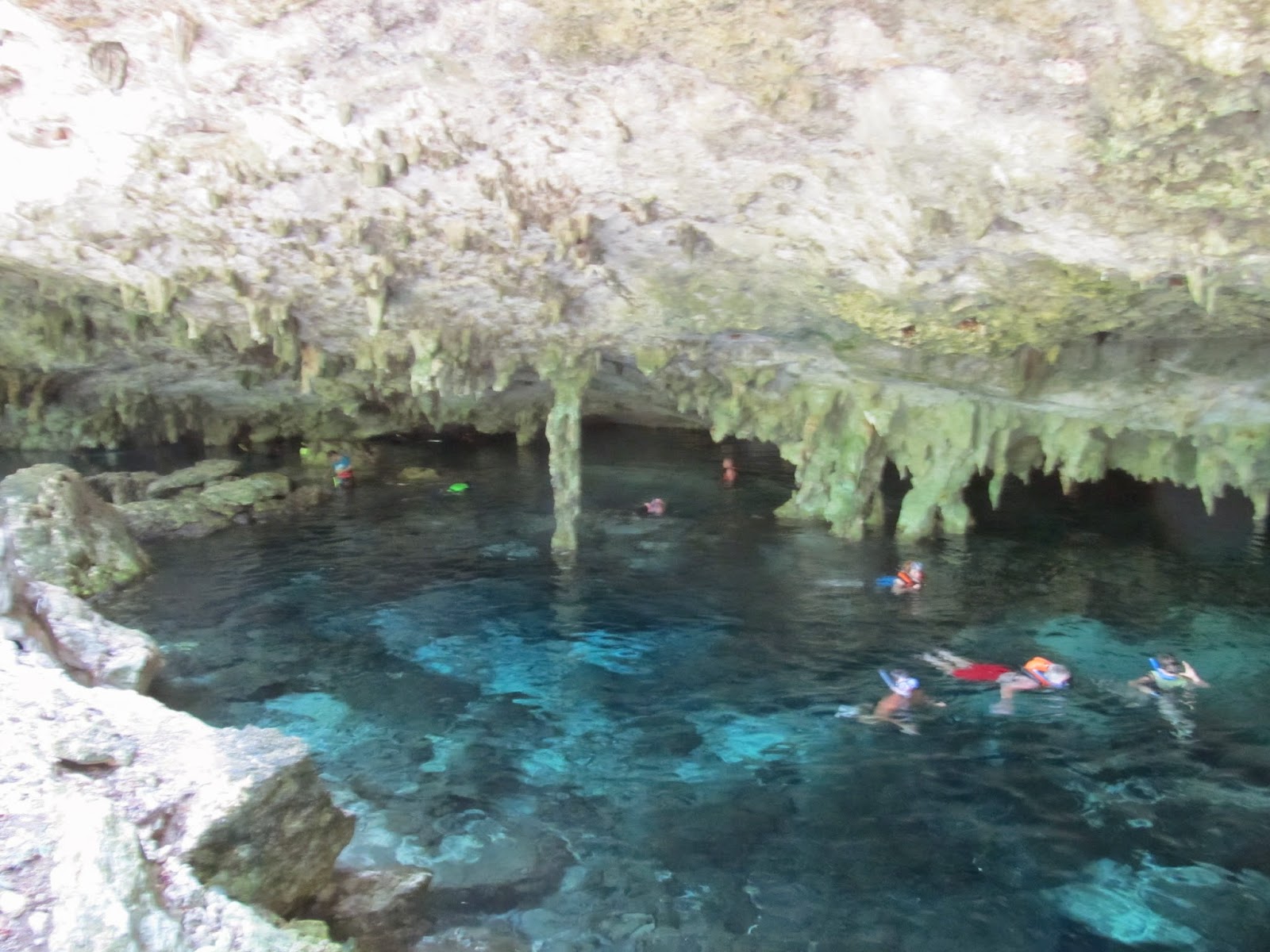
At noon, I headed to the cenote "Dos Ojos" (= two eyes), which was recommended by the husband of the hostel owner, a german guy now living in Tulúm. It is one of the biggest cenotes in the area - actually they are two cenotes - and surrounded by some kind of park with lots of small cenotes. They are called ojos, because they are like circles of water with some kind of island in the middle. At Ojo Uno you only had a small part to swim, and only professional divers were allowed to dive through the tunnels "into the underworld".
Ojo Dos was bigger, you could nearly swim the hole circle (which is about as big as the half of a football field), and there were also tunnels for professional divers. It is really a paradise for diving. The water is so clear you feel like looking through glass. It feels like you can touch the ground if you just dip your finger into the water, while the water actually is about 4 meters deep. There were no colorful fishes to watch, only small brown ones and lots of stone formations, but it still was an amazing experience. All the divers needed some underwater flashlights for the tunnels because it got really dark in there. Most of the people explored the Ojos with snorkels, but I decided not to borrow or buy one, because I am fine with holding my breath pretty long. It's like I am more made for diving than swimming. I even thought about starting professional diving as a hobby but then I realized this might just be another expensive hobby I will never be willing to spend my money for.
After I explored both of the eyes underwater, I decided to relax a little and got to the rest area - some trees with hammocks inbetween them. It was so comfortable that in the end I just chilled there some hours. And then went for another dive in the cenote and so on. I didn't leave the park until all the shop owners started packing their stuff. Now I am absolutely sure that we need some cenotes in Austria!
In the morning I visited the ruins of the mayan city Zama, now known as Tulúm, a city that was built 400 a.d. and controled the yucatan area until the spains arrived at the continent. The city is really lovely and the view is amazing. It even has its own caribbean beach. I was lucky to get there so early, just when the site opened, so the area was not filled with tourists - there were about 6 people at the site. When I got out, about 50 people were waiting at the ticket office, and another 100 were on their way to the ticket office.
At noon, I headed to the cenote "Dos Ojos" (= two eyes), which was recommended by the husband of the hostel owner, a german guy now living in Tulúm. It is one of the biggest cenotes in the area - actually they are two cenotes - and surrounded by some kind of park with lots of small cenotes. They are called ojos, because they are like circles of water with some kind of island in the middle. At Ojo Uno you only had a small part to swim, and only professional divers were allowed to dive through the tunnels "into the underworld".
Ojo Dos was bigger, you could nearly swim the hole circle (which is about as big as the half of a football field), and there were also tunnels for professional divers. It is really a paradise for diving. The water is so clear you feel like looking through glass. It feels like you can touch the ground if you just dip your finger into the water, while the water actually is about 4 meters deep. There were no colorful fishes to watch, only small brown ones and lots of stone formations, but it still was an amazing experience. All the divers needed some underwater flashlights for the tunnels because it got really dark in there. Most of the people explored the Ojos with snorkels, but I decided not to borrow or buy one, because I am fine with holding my breath pretty long. It's like I am more made for diving than swimming. I even thought about starting professional diving as a hobby but then I realized this might just be another expensive hobby I will never be willing to spend my money for.
After I explored both of the eyes underwater, I decided to relax a little and got to the rest area - some trees with hammocks inbetween them. It was so comfortable that in the end I just chilled there some hours. And then went for another dive in the cenote and so on. I didn't leave the park until all the shop owners started packing their stuff. Now I am absolutely sure that we need some cenotes in Austria!
Sunday, 3 August 2014
Ruta de Puuc
Some days ago I received an advice on how the mexicans visit the archeological sites of the mayans and how I get to see sites that are not really touristic and therefore hard to visit. Every sunday there's a bus for the "route of puuc" - puuc is an architectural style that was very common in that area between about 700 and 1000 A.D. - with a bus driver that only speaks spanish and mostly mexican couples and families. We got to visit 5 archeological sites: Labna, Xlapac, Sayil, Kabah and Uxmal.
Some of them were really small, only one or two buildings left that are partially intact, like in Labna which was the first one.
The second one, Xlapac, also only had some ruins left. They all had about 2000 inhabitants in the age of 700 to 1000 A.D. Sayil, the third one, still had a beautiful palace that was mostly intact.
The fourth mayan city we visited was Kabah, which had once been a pretty big city with lots of leftovers, but most of them deep in the jungle and therefore not open for visits. we only got to see the palace. Kabah even had a stone street to be connected to Uxmal, the most important city of this region that time.
I pretty much looked forward to seeing Uxmal, because lots of people told me how beautiful it is and that it is much better than Chichen Itza because you are allowed to go up the pyramid. So when I entered the site, saw the pyramid next to some big building where the nuns lived, and I saw it was prohibited to climb it, I was really disappointed. Really, that's the best part of visiting a mayan city. Well, not exactly the climbing part but standing on top of a pyramid, seeing all the buildings and just enjoying the view. (The following picture was taken from the palace that was built on a kind of hill, not a pyramid.)
I couldn't believe that there was really no mayan city left where you are allowed to go up to the top of a pyramid. So I combed through the area, looked what it had to offer. There was also a ballgame area (of the game I wrote about in the Chichen Itza post), seems like this game was quite popular. And I was lucky - there was another pyramid on the backside of the area, about 80 meters high and open for visitors. Up there there was no place to hide from the sun but the view was worth it.
Some of them were really small, only one or two buildings left that are partially intact, like in Labna which was the first one.
The second one, Xlapac, also only had some ruins left. They all had about 2000 inhabitants in the age of 700 to 1000 A.D. Sayil, the third one, still had a beautiful palace that was mostly intact.
The fourth mayan city we visited was Kabah, which had once been a pretty big city with lots of leftovers, but most of them deep in the jungle and therefore not open for visits. we only got to see the palace. Kabah even had a stone street to be connected to Uxmal, the most important city of this region that time.
I pretty much looked forward to seeing Uxmal, because lots of people told me how beautiful it is and that it is much better than Chichen Itza because you are allowed to go up the pyramid. So when I entered the site, saw the pyramid next to some big building where the nuns lived, and I saw it was prohibited to climb it, I was really disappointed. Really, that's the best part of visiting a mayan city. Well, not exactly the climbing part but standing on top of a pyramid, seeing all the buildings and just enjoying the view. (The following picture was taken from the palace that was built on a kind of hill, not a pyramid.)
I couldn't believe that there was really no mayan city left where you are allowed to go up to the top of a pyramid. So I combed through the area, looked what it had to offer. There was also a ballgame area (of the game I wrote about in the Chichen Itza post), seems like this game was quite popular. And I was lucky - there was another pyramid on the backside of the area, about 80 meters high and open for visitors. Up there there was no place to hide from the sun but the view was worth it.
Subscribe to:
Posts (Atom)